Comparisons
Schuller Kitchen Style Alternative UK: how to compare your options fairly
By Strada Design Team · 8 July 2026 · 11 min read
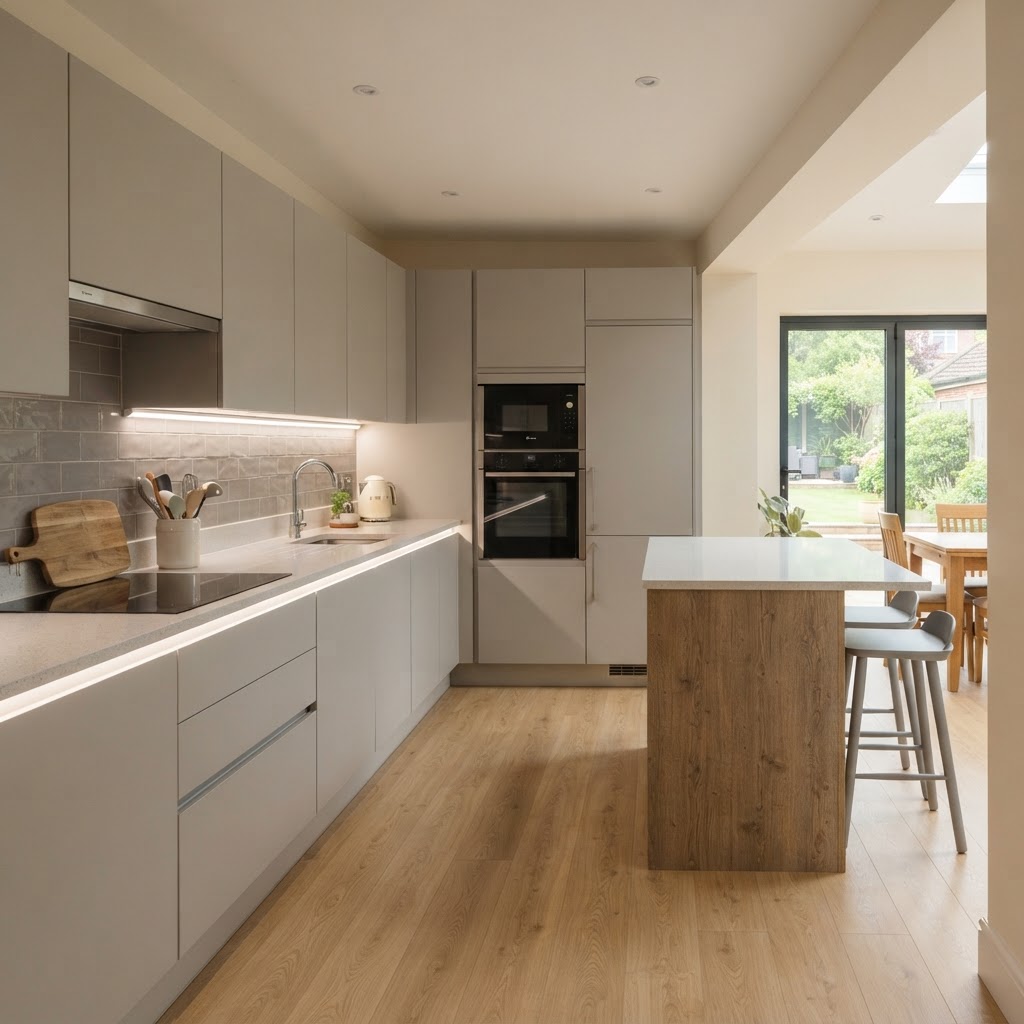
Schuller Kitchen Style Alternative UK: how to compare your options fairly
If you have been searching for a schuller kitchen style alternative uk, you are probably weighing up two things at once: the clean, engineered look you like, and a budget that still feels realistic for your home. That is a sensible place to start. A kitchen can look premium in a brochure, but the real decision comes down to how it is built, how well it fits your room, and how clearly the company explains what you are paying for.
Schüller has a strong reputation for modern German kitchen styling, and it is easy to see why many homeowners are drawn to that aesthetic. Crisp lines, integrated storage, matte finishes and a tidy, architectural feel suit a lot of modern UK homes. But if what you really want is that overall style and standard of engineering, there are other routes worth considering.
For homeowners in Greater Manchester and Cheshire, Strada Bespoke Interiors offers a different kind of option: bespoke kitchens manufactured in Rochdale using German-engineered cabinetry, CNC-manufactured components and a 100% in-house fitting team. That matters because the final result is not only about the door colour or handle profile. It is about how accurately the kitchen is made, how well it is installed, and whether the company helps you make informed decisions rather than pushing you into a package.
Why people look for a Schüller-style kitchen in the first place
Before comparing brands, it helps to separate style from supplier. Many people searching for a Schüller-style kitchen are not looking for one exact badge. They are looking for a combination of features:
- Handleless or low-profile cabinetry for a cleaner visual line
- Matt painted or textured finishes that feel contemporary rather than glossy and overdone
- Efficient storage with drawers, pull-outs and tall units that make day-to-day use easier
- A precise, fitted look with even door gaps and minimal wasted space
- A modern European feel that works well in extensions, open-plan rooms and renovated family homes
Those are all achievable without treating the kitchen as an ultra-luxury purchase. In fact, many homeowners would rather spend carefully on the parts that affect daily use most: drawer quality, cabinet rigidity, layout planning, lighting and installation.
That is where a fair comparison becomes useful. If you like the Schüller look, the right question is not only, “Which brand is closest?” It is, “Which supplier gives me the design language I want, at the build quality, service level and price point that fit my project?”
Schuller kitchen style alternative uk: what you actually need to match
A good schuller kitchen style alternative uk is not about copying one showroom display. It is about understanding which design ingredients create that overall feel and then judging who delivers them well.
Start with the basics:
- Frontals and finishes: look for matt lacquered looks, muted colours, textured woodgrains and slab-style doors.
- Handle treatment: true handleless, rail systems or discreet integrated pulls each change the look and cost.
- Cabinet proportions: deeper drawers, clean tall banks and balanced island design matter more than brand labels.
- Appliance integration: concealed fridge-freezers, built-in ovens and extractor solutions help create that seamless feel.
- Lighting: under-cabinet lighting, shelf lighting and plinth lighting should support function first, then atmosphere.
It is also worth checking whether the design works for the way you live. A very minimal kitchen can look brilliant, but it still needs sensible everyday storage for pans, food, cleaning products and small appliances. That is especially true in UK homes where utility space is not always generous.
For example, if you are planning an island, aim for around 1000 to 1200mm of working aisle where drawers or appliances will be in use. If you need a walkway behind seating, 900mm is a practical minimum. These are the kinds of measurements that turn a good-looking kitchen into a kitchen that works properly.
Compare cabinet construction, not just the showroom finish
This is the part many homeowners do not see until much later. Two kitchens can look similar from the front, but perform very differently over time.
At Strada, kitchens are CNC-manufactured. CNC means computer-controlled cutting and drilling, which helps create consistent, repeatable accuracy across every panel. In simple terms, parts are made to precise dimensions so cabinets assemble and align properly.
Strada also uses German-engineered cabinetry and Lamello Cabineo fixings. If you have not come across Cabineo before, it is a modern cabinet connector used in precision joinery. For a homeowner, the important point is that it supports strong, accurate assembly without the rough-and-ready feel of lower-grade flat-pack construction.
Another useful term to understand is carcass tolerances. That simply means the acceptable variation in cabinet sizes during manufacturing. Tighter tolerances help produce neater door alignment, more consistent filler panels and a more refined fitted look. You may never ask for a tolerance sheet, but you will absolutely notice the result when drawers line up cleanly and tall units sit square.
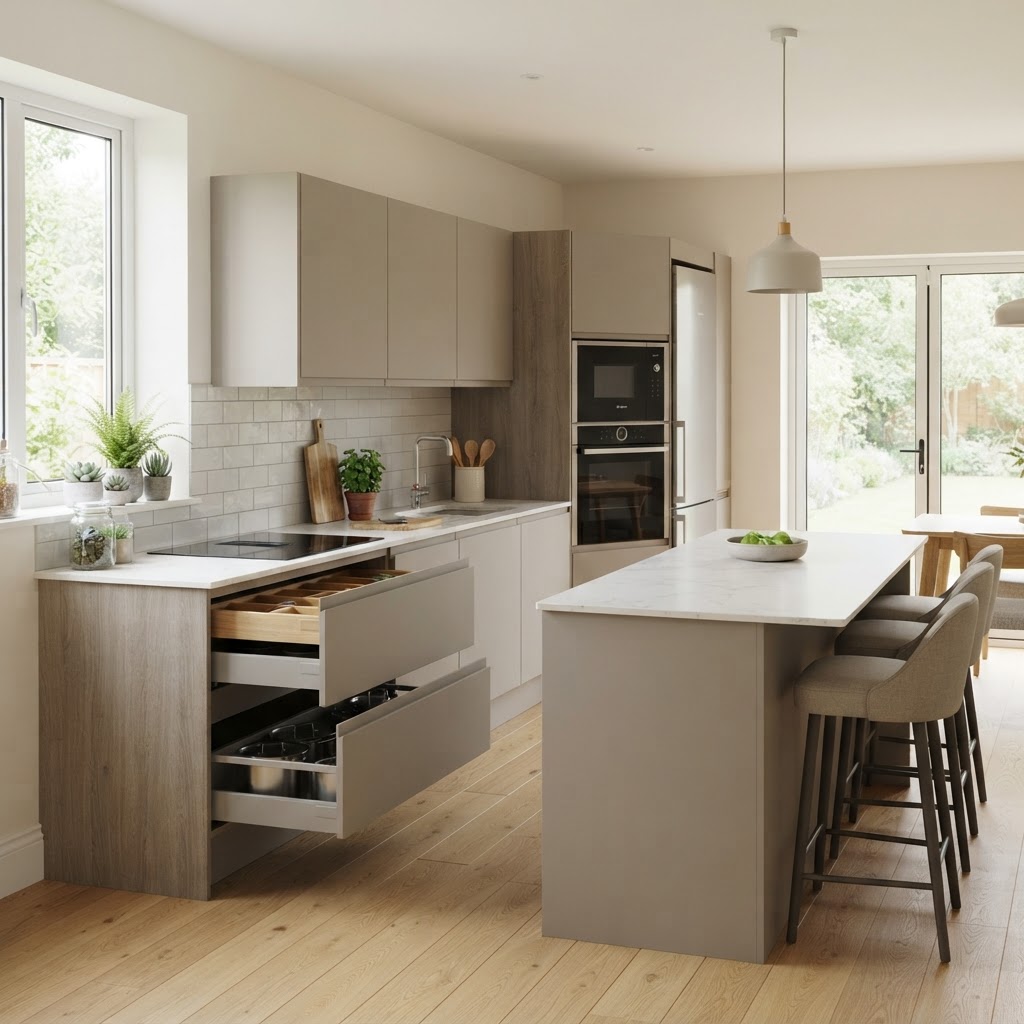 Clean-lined German-style design without pushing into ultra-premium pricing.
When you compare suppliers, ask practical questions like these:
- Are the cabinets manufactured to order or pulled from a standard stock range?
- How much flexibility is there for awkward walls, chimney breasts or uneven rooms?
- What fixing system is used in cabinet construction?
- Who installs the kitchen, and are they in-house or subcontracted?
- What warranty is offered on the kitchen furniture?
Strada offers a 25 years minimum warranty on kitchens and uses a 100% in-house installation team, with no subcontractors. That will not matter to every buyer in the same way, but it is an important difference if you want accountability from design through to fitting.
How mainstream, premium and bespoke alternatives differ
If you are comparing options fairly, most homeowners will find themselves looking at three broad groups.
1. Mainstream national retailers such as Wren, Magnet, B&Q and IKEA can be a sensible route for many projects. Their strengths are usually accessibility, broad style ranges and a straightforward showroom process. For some homes, especially simpler room shapes, they can offer decent value and a quick route to a finished kitchen.
The trade-off is often flexibility. Standard cabinet ranges can mean more fillers, more compromises around awkward spaces and fewer ways to tailor a design neatly around the room. Installation arrangements can also vary from one retailer to another, so it is worth asking who will actually be fitting the kitchen and how problems are handled if they arise.
2. Premium crafted brands such as Harvey Jones appeal to buyers who want a more furniture-led, service-heavy experience. Their strength often lies in craftsmanship, painted finishes and a very considered design journey. For some homes, particularly period properties, that may be exactly the right fit.
The trade-off is that this route often sits at a higher spend level, and the styling emphasis may be less aligned with the crisp German-inspired look that many Schüller buyers are after.
3. Bespoke local manufacturers like Strada sit in a useful middle ground for many homeowners. You can get a tailored layout, locally managed service and more control over the details, without defaulting to an ultra-premium framing. Strada’s average project value is £5,000 to £10,000, which is important because it means bespoke does not automatically have to mean out of reach.
If you want to get a feel for how that translates into real homes rather than idealised showroom sets, it helps to browse completed kitchen projects and compare layouts, finishes and room types.
Where Strada differs as an alternative
If you are using the term schuller kitchen style alternative uk because you like the engineering and clean design language, Strada’s difference is not that it tries to imitate another brand. It is that it offers many of the qualities people value in German-style kitchens, but through a local, bespoke and more directly managed process.
That difference shows up in a few practical ways:
- Bespoke planning: better use of awkward rooms, alcoves and non-standard wall lengths
- Manufacturing accuracy: CNC production helps keep cabinet parts consistent
- Robust cabinet construction: German-engineered cabinetry with Lamello Cabineo fixings
- Direct accountability: no subcontracted fitting teams
- Real-world pricing: a typical project range that stays grounded for ordinary homeowners
It is also worth saying what this does not mean. It does not mean every Strada kitchen will be cheaper than every Schüller kitchen, because design choices, room size, appliance selection and worktops all affect the final figure. And it does not mean a national or premium retailer is the wrong choice. It simply means you should compare like with like: cabinet quality, design flexibility, fitting quality, warranty and how transparent the quote feels.
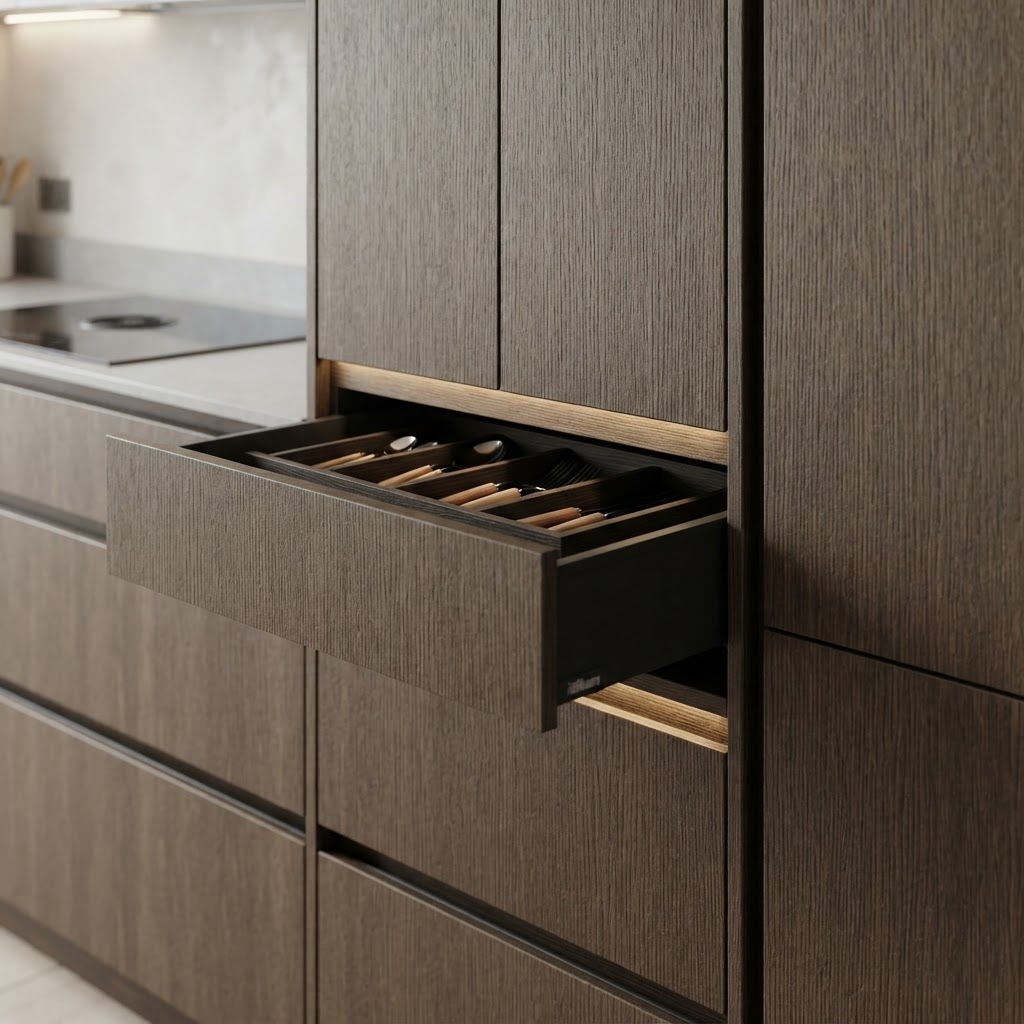 Consistent door gaps and smart storage matter as much as looks.
If you want more detail on Strada’s approach, the why choose Strada page explains how the design, manufacturing and installation process works.
A practical showroom and quotation checklist
Whether you are comparing Strada with Schüller, or with several other brands at once, use the same checklist each time. That keeps the decision grounded.
- Ask what is included in the quoted price. Clarify cabinets, panels, handles or rail systems, worktops, appliances, lighting, delivery and fitting.
- Check for filler dependence. A design with excessive fillers may suggest the room is being forced into standard sizes rather than planned around properly.
- Open the drawers and tall units. Look for smooth movement, stability and a solid feel when fully loaded.
- Study the end panels and internals. Neat finishing matters just as much as the front view.
- Ask who measures and who fits. A handover between too many parties can create avoidable mistakes.
- Talk through your daily routine. Where will the kettle live? Where do bins go? Can food storage sit close to prep space? Good design answers these quickly.
- Check the warranty in plain terms. Strada offers a 25 years minimum kitchen warranty; compare how clearly others explain theirs.
Also pay attention to how the company communicates. Good kitchen firms do not hide behind vague phrases like “premium quality”. They explain the cabinet construction, planning logic and cost drivers in plain English.
Who this type of kitchen suits best
A German-style kitchen alternative tends to work especially well if you want a space that feels calm, ordered and contemporary without being flashy. It suits:
- open-plan kitchen diners where visual clutter needs to be controlled
- extensions where tall banks and islands become part of the room architecture
- busy family kitchens that rely on drawers and hidden storage to stay organised
- smaller kitchens that benefit from tailored planning rather than standard off-the-shelf layouts
If your taste leans more towards in-frame timber, decorative mouldings or a deliberately traditional feel, another route may fit better. But if your priority is clean design, consistent build quality and a kitchen that feels well-resolved rather than overstyled, this category is worth serious consideration.
There is no single correct answer. Some buyers will prefer the convenience of a national showroom network. Others will want a more premium heritage aesthetic. And some will find that a locally manufactured bespoke kitchen gives them the best balance of design freedom, durability and price clarity.
FAQs
Is a Schüller-style kitchen always expensive?
No. The look itself does not have to sit at the very top end of the market. Cost depends on room size, cabinet specification, worktops, appliances and installation. A well-planned bespoke kitchen can deliver a similar clean-lined result without automatically moving into ultra-premium pricing.
What makes a good German kitchen alternative UK buyers should check first?
Start with cabinet construction, layout flexibility and installation standards. Door style is only one part of the result. Ask how the cabinetry is made, who installs it, what warranty is included and whether the design uses your room efficiently rather than relying on standard-size compromises.
Are handleless kitchens practical for family homes?
Yes, provided the layout is planned well and the handleless system is comfortable to use. They work especially well with deep drawers and integrated storage. The key is making sure everyday items are easy to reach, so the kitchen stays tidy without feeling awkward.
Why does an in-house fitting team matter?
It creates clearer accountability. If the same company is responsible for design, manufacture and installation, there is less chance of issues being passed between separate parties. Strada uses a 100% in-house installation team, which can make communication and problem-solving more straightforward.
If you want to compare layouts, finishes and budgets in your own space, you can book a free in-home design consultation. It is a practical way to see whether a Strada kitchen is the right fit for the style you want.